Quantum Computing & Machine Learning Researcher
Published on quantum computing for biological regulatory networks, now authoring work on ML transformers accelerating vaccine development in rapid-response contexts.
Quantum Computing & ML Researcher
Since July 2024, I have been working with the University of Saskatchewan's Vaccine and Infectious Disease Organization (VIDO) which is one of Canada's top vaccine and immunology research centers.
Role Focus
- Quantum Computing (Gate-based) & Grover's Algorithm.
- Machine Learning (Transformer models) for epitope selection.
- Computational Immunology & Vaccine Development.
- Solving B-SAT Problems on limited datasets.
Key Contributions
- Published paper in 2025 IEEE QCE Conference.
- Ran experiments on real IBM 127-qubit quantum hardware.
- Utilized 75,000+ CPU-hours for simulation/training.
- Developing two novel approaches for accelerating molecular docking.
Tools & Standards
Uncovering Regulatory Logic with Quantum Computing
I have been working part-time in addition to other commitments and work has focused on applying novel computational techniques including quantum computing and machine learning (transformer models) to accelerate vaccine development and better understand regulatory networks within the immune system using very limited data.
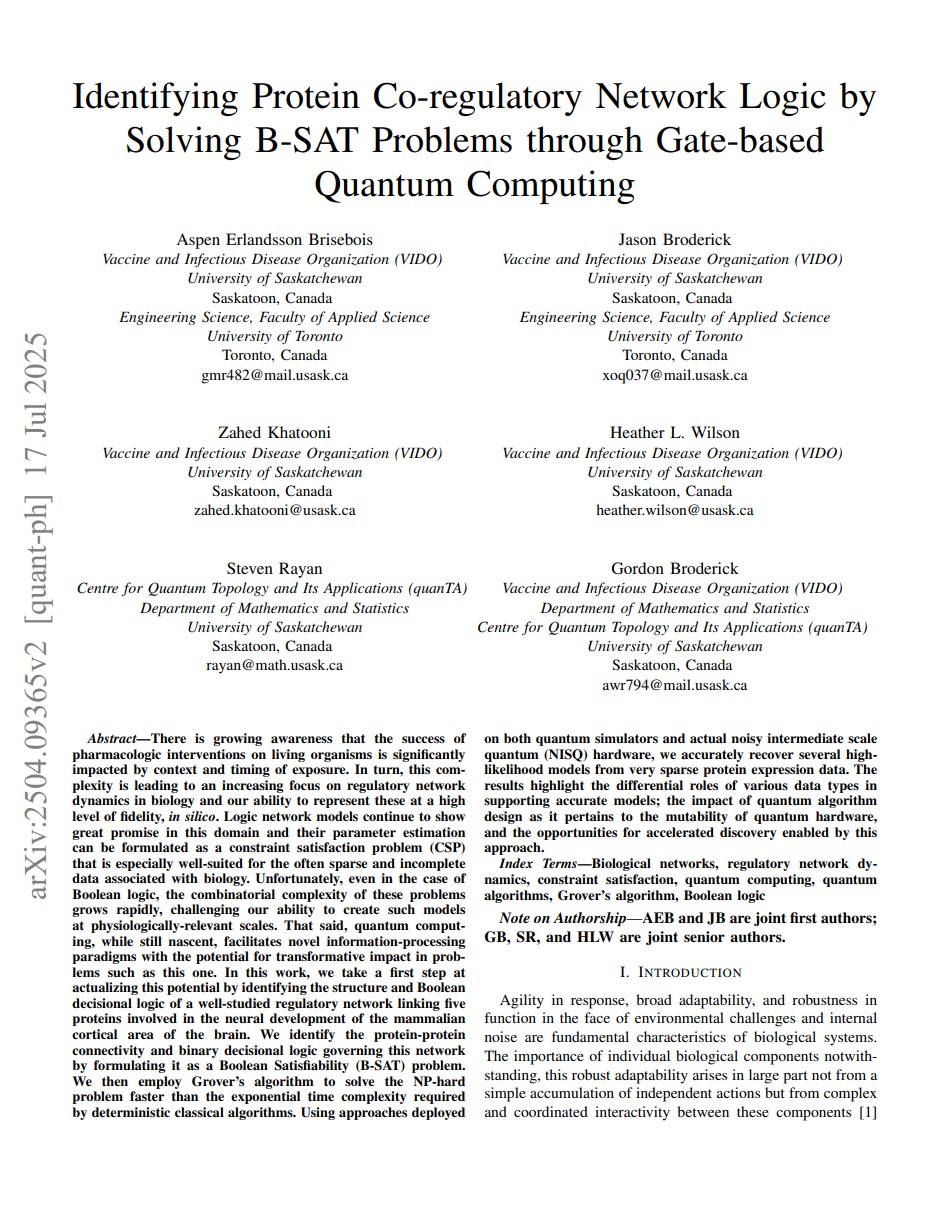
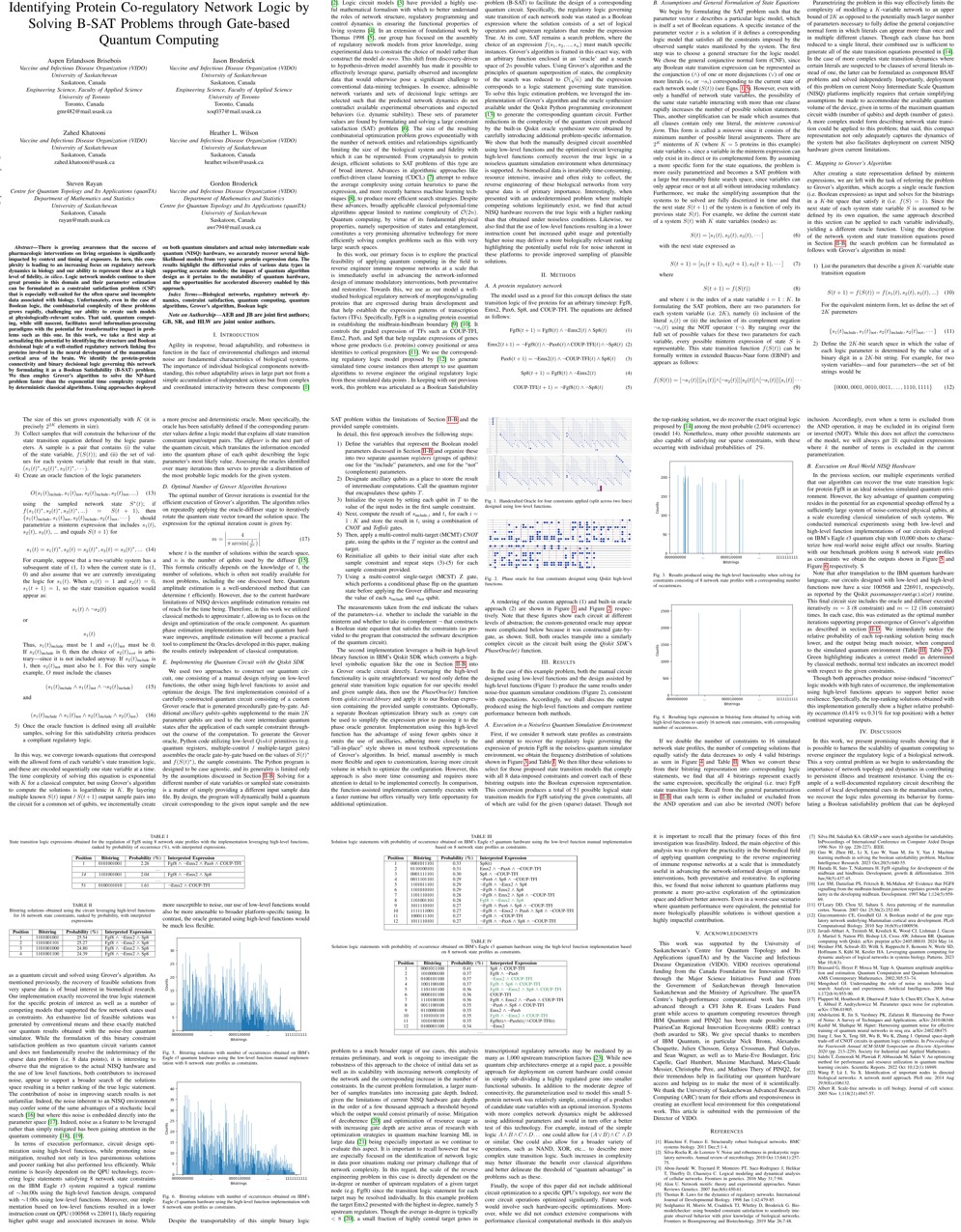
The first paper I spearheaded reported on a new technique we developed titled "Identifying Protein Co-regulatory Network Logic by Solving B-SAT Problems through Gate-based Quantum Computing". We use quantum computing (running on a real IBM 127-qubit machine) to uncover regulatory logic within the immune system from a limited number of state-transition samples.
Quantum computing is particularly well suited to this task since the number of possibilities grows exponentially with parameter count of the regulatory network, and using Grover's algorithm we transformed the problem to take advantage of the super-exponential speedup quantum computers offer in this domain.
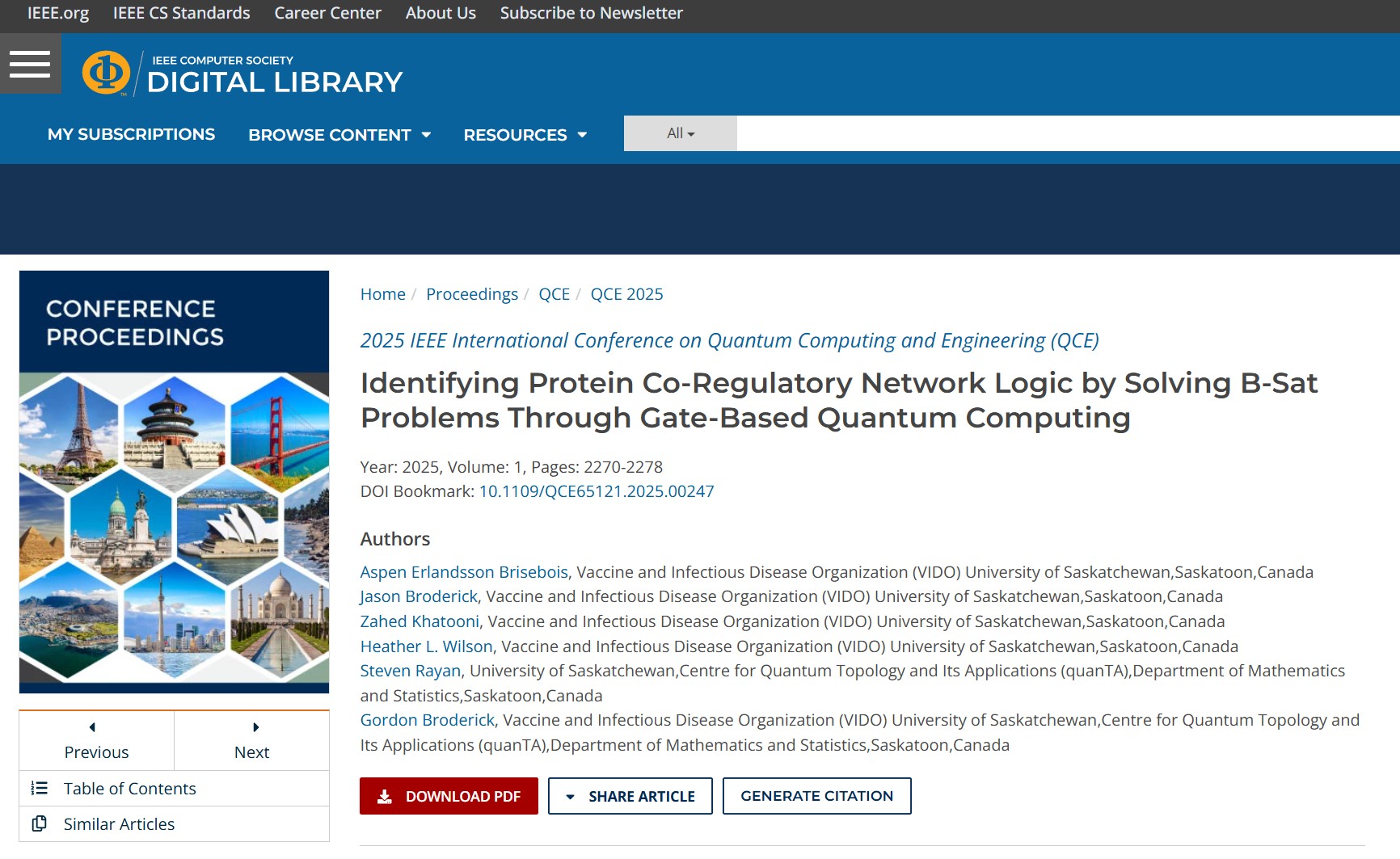
The full paper is available on arXiv, and was published in the 2025 IEEE International Conference on Quantum Computing and Engineering (QCE).
Read on arXiv: https://arxiv.org/abs/2504.09365
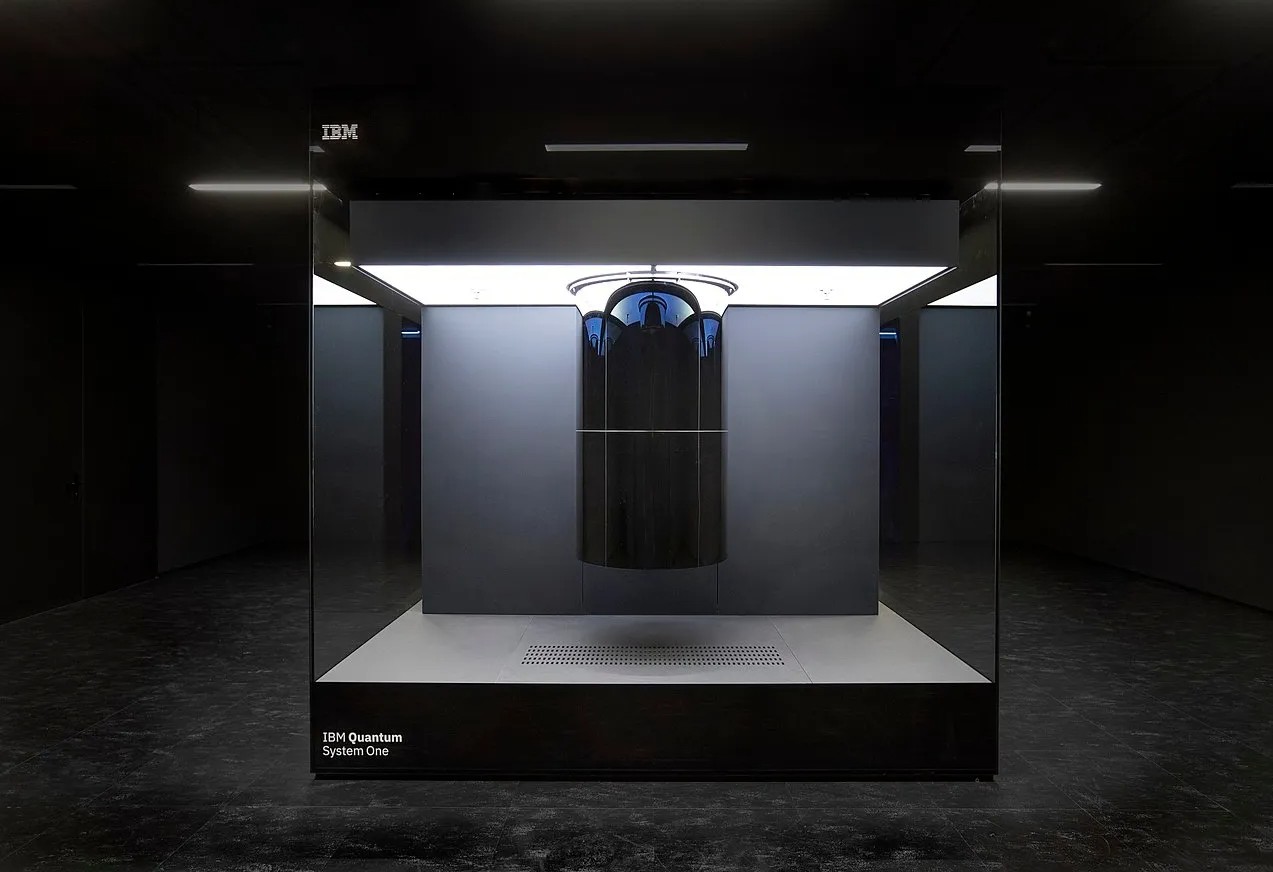
More recently, I have also started working directly with Canada's first and only IBM Quantum System One located in Quebec, which represents the most advanced quantum hardware system available today.
Accelerating Epitope Selection
Now, my work is focused on accelerating "epitope" selection for vaccine development, which is a critical (and time consuming) aspect of the process. Determining how well a particular epitope binds to a particular receptor within the immune system is key in deciding if it's viable for a vaccine, and currently the best way to do this is molecular docking simulations.
Molecular docking simulations can take 24-48 hours per epitope, so it's highly desirable to accelerate the process. To address this, I have been spearheading two approaches which will each become two new papers in addition to my first published one:
- Using Quantum Machine Learning (QML) techniques, exploiting the quantum-nature of the docking problem to perform better than classical machine learning techniques under very-low data conditions (think as low as 10 samples total). This is work-in-progress.
- Using classical, but state of the art, machine learning techniques involving transformers, active learning, hyperparameter optimization, and cross validation to build a resilient framework for fast response training and deployment. This is done in draft form, the paper is undergoing internal review.
Workflow & Collaboration
My day-to-day activities involve working with Python, particularly through libraries such as Qiskit (Quantum), and PyTorch (Machine Learning) in conjunction with hand-derivations, reading other research work, and collaborating with team-members to develop our methods. Once methods have been developed and validated, I write the paper describing precisely what was done and its implications, then a review cycle hammers out the draft before being submitted for independent peer review.
I report weekly to supervisors and coordinate with team-members throughout the week, and have made extensive use of our high performance compute (HPC) platform, with 75,000+ CPU-hours dedicated to quantum simulations in 2025 alone.
Conferences
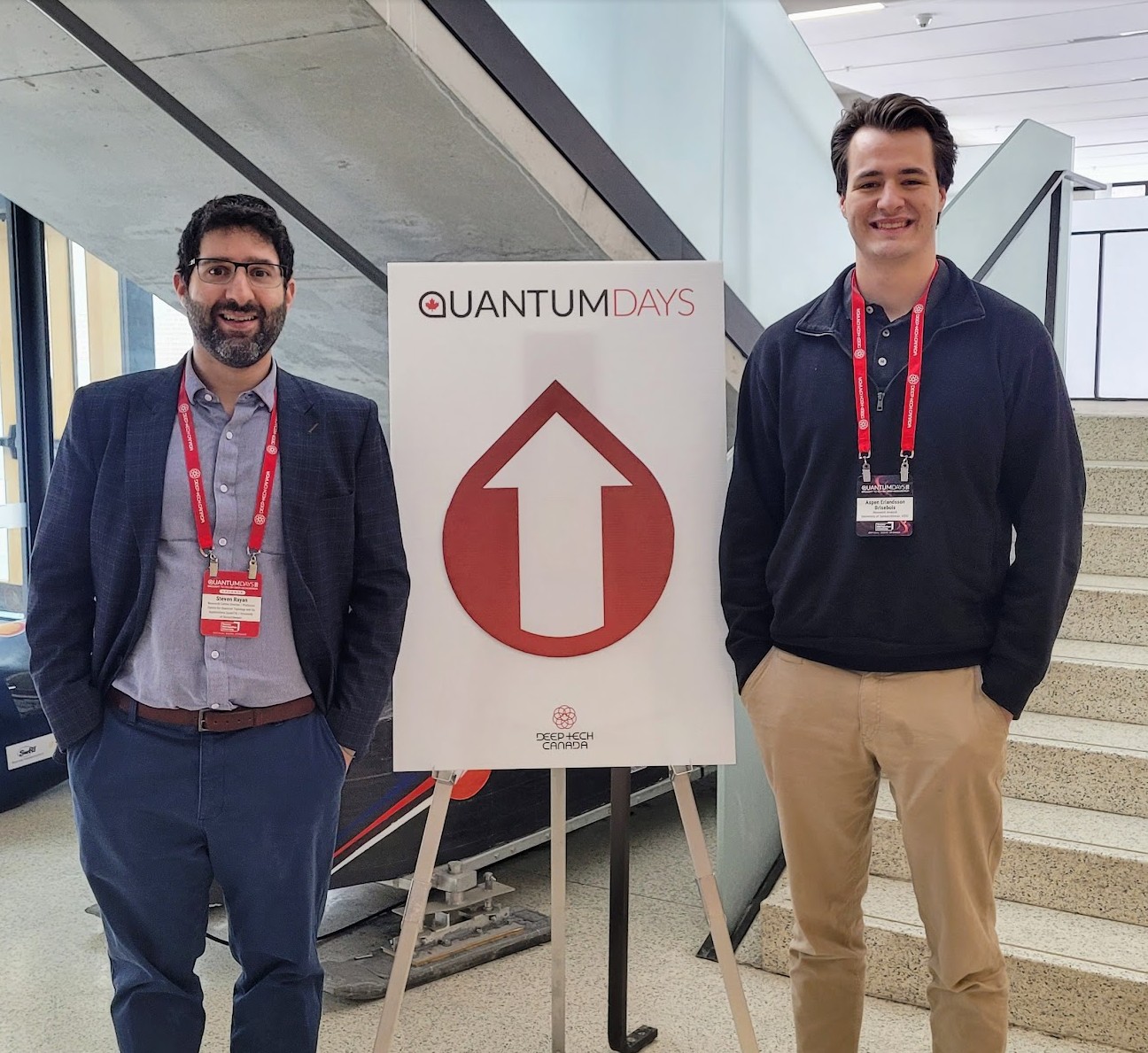
I also had the exciting opportunity to attend the Quantum Days 2025 conference here in Toronto. Below is a photo of myself posing with one of my supervisors, Dr. Steven Rayan.